
Case Summary
On 17 December 1993, a man’s body was found beneath a railway arch on Wyre Street, opposite Manchester Piccadilly station. It had been partly burned and the head was missing. There were no documents or belongings that allowed police to identify him, and nothing immediately explained why he had been left in the centre of a city just before Christmas.
The disposal suggested two intentions. Fire had been used to damage the body, while decapitation removed the feature most likely to prompt recognition. Yet the body had not been hidden in a remote grave. It was left where it would be found, creating a murder inquiry whose first challenge was to discover the victim’s name.
Greater Manchester Police circulated what physical information could be recovered and checked missing-person reports, but no answer emerged. The absence of an identification also concealed the geography of the crime. Investigators did not yet know that the man lived in London and, according to police, had no known connection with Manchester.

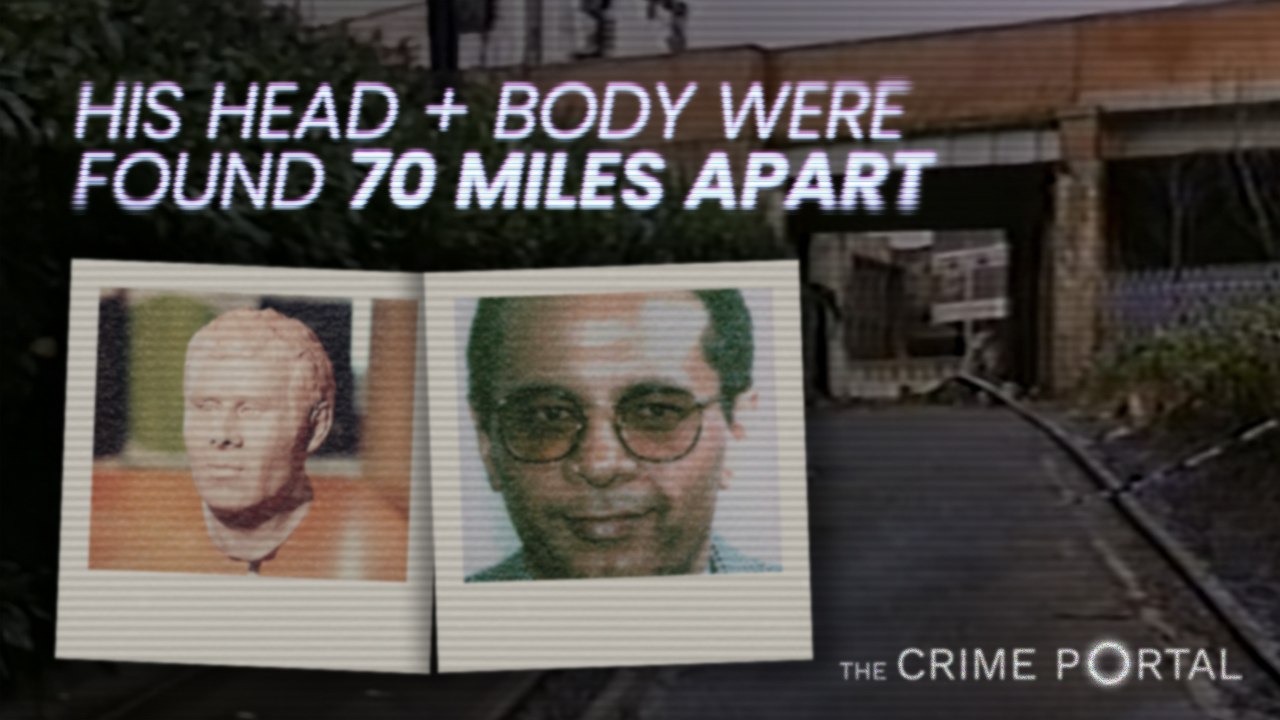
Exhibit A: Case image for the Adnan Abdul Hameed Al Sane investigation. Source: The Crime Portal archive.
A second discovery in Staffordshire
On 27 January 1994, roughly six weeks after the Manchester discovery, a severed head was found on a playing field at Cheslyn Hay near Cannock, Staffordshire. It was about 70 miles from the body and close to the M6, raising the possibility that it had been thrown from a passing vehicle.
DNA testing showed that the head and body belonged to the same man. Examination also established that the head had been removed after death. The face had been deliberately damaged with a bladed implement, described in contemporary reporting as an axe or machete, making ordinary visual identification impossible. A swallowed tooth indicated that the victim had suffered violence while still alive.
The separation of the remains across two police areas greatly complicated the investigation. It also raised questions that remain unanswered: where was the man actually killed, why were Manchester and Cheslyn Hay selected, and how many people and vehicles were involved in moving the remains?
“Financial motive is the only one I can think of, unless someone tells us something to the contrary.”
Detective Superintendent Bernard Rees, Greater Manchester Police
The face rebuilt from evidence
With recognition deliberately frustrated, police turned to forensic artist Richard Neave of the University of Manchester. Working from the skull, Neave reconstructed an approximation of the man’s face. The result was not intended to be a portrait; it was a carefully reasoned likeness that might trigger recognition when published.
The reconstruction reached a solicitor who believed the face resembled a missing client. That lead directed police to a flat in Maida Vale, west London. Fingerprints and dental records confirmed the identification: the victim was Adnan Abdul Hameed Al-Sane, a 46-year-old Kuwaiti businessman and former banker.
The identification demonstrated why the killer’s efforts had nearly succeeded. Adnan had not been reported missing in Manchester or Staffordshire because his life was based in London. Without the reconstruction, the two discoveries might have remained attached only to an unidentified victim. Instead, investigators could finally examine his movements, finances and relationships.

From Kuwait to London
Adnan came from a wealthy Kuwaiti family and had been involved in a bank he partly owned. He retired at the age of 38 and settled in London, where he continued to deal in stocks and shares. Contemporary reports described him as a millionaire and placed his home in Maida Vale.
He was last known to be alive at a London hotel in mid-December 1993, only days before his body was found in Manchester. The surviving public record does not provide a verified journey north. There is no confirmed sighting of Adnan in Manchester and no clear reason for him to travel there voluntarily.
Once police searched his flat, they found that six box files connected with his investments were missing. The removal of financial records suggested that the motive might lie in business rather than in a random encounter. It also introduced the possibility that the killer wanted not only to prevent identification but to conceal or obtain information about Adnan’s dealings.

“It’s bizarre and mystifying.”
Detective Superintendent Bernard Rees, Greater Manchester Police
Money, violence and an unresolved motive
In April 1994, detectives examined a possible connection with a double shooting in Paddington. A man and woman, both 31, had been shot and seriously injured. The male victim was a business associate whom Adnan was suing in the High Court for the recovery of £600,000. Police in Manchester and London liaised over the cases, but no public evidence established that the gun attack and Adnan’s murder were committed by the same people.
The financial dispute, the missing files and the deliberate effort to obscure Adnan’s identity all gave detectives reason to consider money as a motive. None of those circumstances proves who killed him. A civil claim is not evidence of murder, and the investigation did not produce a charge against the wounded associate or anyone else.
Adnan’s case therefore ends with an unusual mixture of forensic success and investigative uncertainty. Science reunited the remains; facial reconstruction supplied a name; fingerprints and dentistry confirmed it. What those methods could not recover was the missing journey between London, Manchester and Staffordshire. No one has been convicted, and the central questions—where Adnan was killed, who transported him, and what they hoped to gain—remain open.